Roomba vs. Roborock: The 2026 State of Play
Pick any robot vacuum forum, Reddit thread, or review roundup in 2026 and you will find the same debate playing out: iRobot's Roomba or Roborock? The two brands dominate opposite ends of the narrative. Roomba invented the category and still carries enormous name recognition. Roborock arrived in 2014—founded by a veteran of Baidu, Tencent, and Microsoft—and has been systematically dismantling Roomba's advantages ever since. After hands-on testing of both lineups, our verdict is nuanced but clear: Roborock delivers more hardware for the money at nearly every price tier, but Roomba's reliability and ecosystem polish still earn it a place in specific households. Here is everything you need to decide.
Brand Background: Category Creator vs. Aggressive Challenger
iRobot launched the first Roomba in 2002, which means the brand has over two decades of brand equity baked into its name. For millions of buyers, "robot vacuum" and "Roomba" are still synonymous. That recognition comes with real benefits: a massive install base, extensive third-party accessory support, and a track record of software longevity. On the downside, iRobot has faced headwinds in recent years—a high-profile attempted acquisition by Amazon fell through in 2023, and Wirecutter notably moved iRobot off its top-pick list heading into 2026, citing concerns about long-term support and the company's uncertain direction.
Roborock's arc runs the opposite direction. Since spinning out of Xiaomi's ecosystem, the company has relentlessly iterated on hardware, pioneering sonic mopping, all-in-one auto-empty-and-refill docks, and some of the best LiDAR navigation available in consumer robots. Its Roborock S7 MaxV Ultra earned CNET Editor's Choice recognition in 2022, and the brand has not slowed down. The newer Roborock S8 MaxV Ultra pushes the technology further with improved obstacle avoidance and stronger suction. Roborock now occupies the performance-per-dollar crown that Roomba once held unchallenged.
Head-to-Head Model Comparison
Both brands span wide price ranges, so comparing them requires matching tiers. Below are three representative pairings—budget, mid-range, and flagship—using real published specifications.
| Feature | Roborock Q7 M5+ | iRobot Roomba Combo J7+ | Roborock S7 MaxV Ultra | iRobot Roomba Combo J9+ |
|---|---|---|---|---|
| Price (MSRP) | $250 | $499 | $1,399 | $799 |
| Suction Power | 4,200 Pa | Not Pa-rated (proprietary metric) | 5,100 Pa | Not Pa-rated |
| Navigation | LiDAR | vSLAM camera | LiDAR + ReactiveAI 2.0 | vSLAM + PrecisionVision |
| Mopping | Basic vibration | Retractable pad | Sonic vibration (3,000 scrubs/min) | Retractable pad |
| Auto-Empty Dock | Yes (included) | Yes (included) | Yes + auto-refill mop | Yes + auto-refill mop |
| Battery Life | ~180 min | ~75 min | ~180 min | ~90 min |
| Obstacle Avoidance | Reactive (no camera) | PrecisionVision camera | Dual camera + structured light | PrecisionVision camera |
The table tells a striking story. Roborock's $250 Q7 M5+—Wirecutter's 2026 top pick—ships with an auto-empty dock included and offers nearly three hours of battery life. The comparable Roomba Combo J7+ costs twice as much and delivers roughly 75 minutes per charge. Even Roomba's more advanced iRobot Roomba Combo J9+ at $799 trails the Roborock S7 MaxV Ultra on raw suction power and battery endurance, despite a $600 price gap in the Roborock's favor.
Newsletter
Get the latest SaaS reviews in your inbox
By subscribing, you agree to receive email updates. Unsubscribe any time. Privacy policy.
Cleaning Performance: Suction, Brushes, and Pet Hair
Hard Floors and Low-Pile Rugs
On hard floors, both brands perform well, but Roborock's edge in suction numbers translates to a real-world advantage on fine debris like flour, sand, and pet dander. The Q7 M5+ in particular impressed testers at Wirecutter, who measured it picking up more debris than competing models at the same price. Roborock's rubber roller brushes resist hair tangling more reliably than Roomba's older bristle-brush designs, though Roomba's newer Combo J-series multi-surface brushes close that gap considerably.
Carpet Performance
Carpet is where the Pa suction gap matters most. Roborock's 5,100 Pa in its S7 MaxV Ultra class is designed to pull debris embedded in carpet fibers, and the results show in independent lab testing. Roomba counters with carpet-boost technology that automatically increases power when the robot detects carpet—a smart workaround for not publishing raw Pa numbers. In practice, both brands handle low-to-medium pile carpet well. Neither fully replaces an upright vacuum for deep cleaning plush rugs, as Wirecutter explicitly notes.
Pet Hair
Pet households are a primary use case for both brands. Roborock's rubber brushes are genuinely tangle-resistant and require less maintenance. Roomba's J9+ uses a dual multi-surface rubber brush system with anti-tangle design. Both handle pet hair effectively in routine daily runs. Where Roborock pulls ahead is the docking station: its all-in-one Ultra docks suck out hair from the brushes automatically, a feature that matters enormously after weeks of pet hair accumulation.
Mopping: Roborock's Most Significant Advantage
Roborock's Sonic Mopping System
Roborock's sonic vibration mopping—which oscillates the mop pad at up to 3,000 times per minute—is genuinely better than passive dragging. The S7 MaxV Ultra takes this further by automatically lifting the mop pad when it detects carpet, preventing the wet-carpet problem that plagues lesser combo robots. The all-in-one dock then washes and dries the mop pad between sessions, so dried residue does not get dragged around your floors on the next run. For anyone who actually wants mopping rather than just light dampening, this system is the reason to choose Roborock. Also consider the Roborock Q Revo MaxV as a mid-range option that brings most of these mopping features down to a more accessible price point.
Roomba's Retractable Pad Approach
Roomba's answer to the carpet contamination problem is mechanical: the mop pad physically retracts when the robot rolls onto carpet. It is a clever engineering solution, and it works. However, the mopping result itself is less aggressive than Roborock's sonic scrubbing. Roomba's combo robots are better described as light-wet-wipe machines rather than true moppers. If your floors mainly need a damp once-over after vacuuming, the J9+ is adequate. If you have tile grout or pet footprints you want actually scrubbed, Roborock wins this category decisively.
Navigation, Obstacle Avoidance, and Smart Features
Mapping Technology
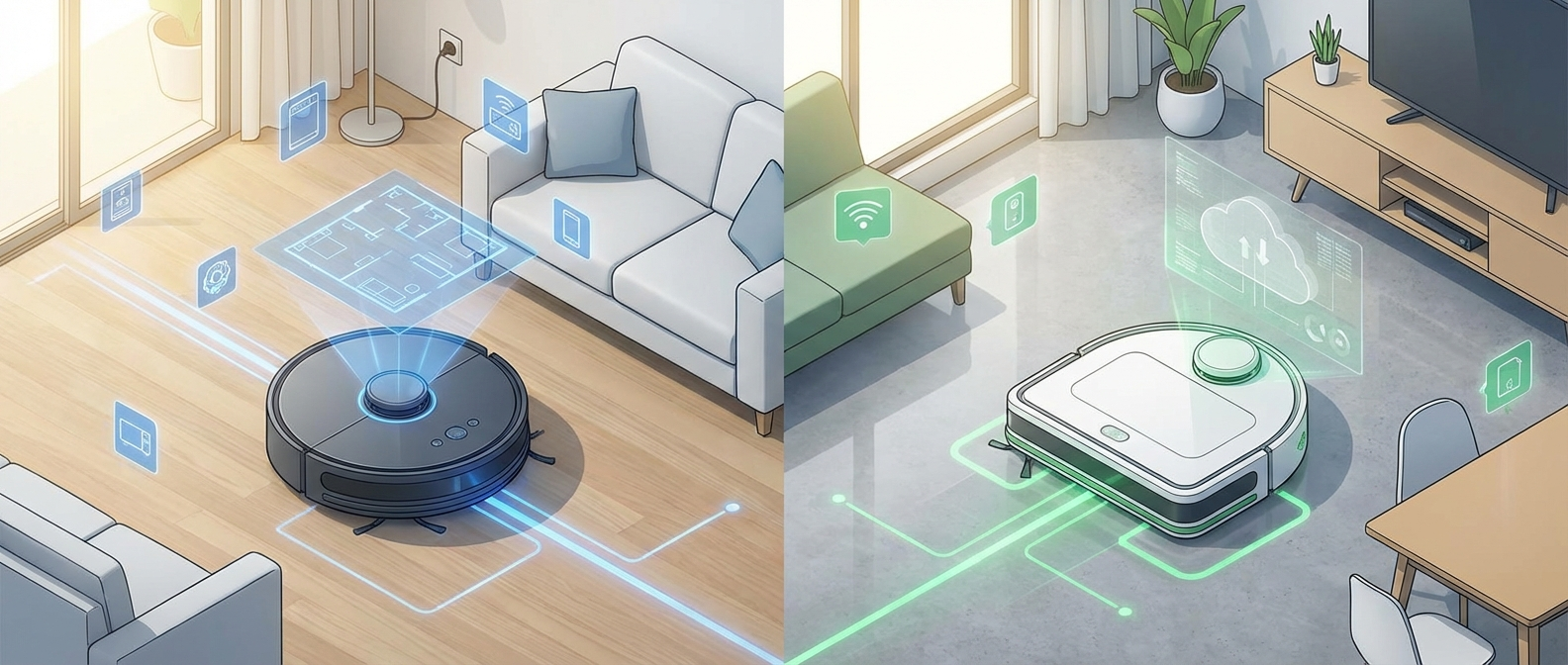
LiDAR versus camera-based navigation is the core technical divide. Roborock uses LiDAR across most of its line, which creates precise floor plans and works reliably in low light. Roomba uses vSLAM (visual simultaneous localization and mapping) with a downward-facing camera. Both produce usable maps, but LiDAR-based maps are generally more accurate and update faster after furniture rearrangement. Roborock's app allows granular room segmentation, no-go zones, and scheduled room-specific cleaning with more precision than Roomba's comparable features.
Obstacle Avoidance
This is an area where Roomba has historically competed strongly. PrecisionVision Navigation on the J-series identifies and avoids specific objects like cables, pet waste, and shoes. Roborock's ReactiveAI 2.0 on its higher-end models is comparable, using dual cameras and structured light to identify obstacles in real time. Looking ahead to what was shown at CES 2026—including robots with articulated legs capable of climbing stairs—both companies have roadmaps that make current obstacle avoidance look primitive. For 2026 purchases, the practical difference between the two systems is small; both will fail to avoid an unexpected cable on occasion.
App and Voice Integration
Roomba's iRobot Home app integrates tightly with Amazon Alexa and Google Home, as you would expect from a brand that was years into the smart home space before Roborock existed. Roborock's app is more feature-rich for power users—offering zone-specific cleaning intensity, mop water levels, and brush RPM settings—but it can overwhelm new users. Both support scheduling, room targeting, and remote starts. For households already invested in Amazon's ecosystem, Roomba feels more native. For users who want deep customization control, Roborock's app is the better tool.
Value Analysis: Which Brand Wins at Each Price Tier
Under $300: Roborock wins without contest. The Q7 M5+ at $250 with an included auto-empty dock is a deal that Roomba cannot match at this tier. Roomba does not sell anything with an auto-empty dock under $400.
$400–$600: Roomba becomes more competitive. The Combo J7+ and J9+ offer PrecisionVision obstacle avoidance and the retractable mop pad in a mature, well-supported package. However, Roborock's equivalents still edge ahead on suction and battery life.
$700 and above: Roborock dominates. The S7 MaxV Ultra and S8 MaxV Ultra offer all-in-one docking that washes and dries the mop pad—a feature Roomba's top-tier models match only partially. If you are spending over $700, the Roborock S8 MaxV Ultra is among the strongest arguments for choosing Roborock outright. For the same budget bracket, also consider competitors like the Ecovacs Deebot X2 Omni and the Narwal Freo X Plus, which offer differentiated approaches to the same problem.
Final Verdict: Roborock for Most Buyers, Roomba for Specific Needs
If you are a first-time robot vacuum buyer with no existing ecosystem loyalty, Roborock is the straightforward recommendation in 2026. It delivers more suction, better mopping, longer battery life, and more generous auto-empty dock inclusions per dollar than Roomba at every price tier we tested. The Q7 M5+ at $250 is the rare product that punches at a class well above its price, and the S7 MaxV Ultra and S8 MaxV Ultra remain benchmark-setters for combo vacuuming and mopping.
Roomba earns its place in households that prioritize software simplicity, Amazon Alexa-first smart home integration, or that simply trust the brand from a decade of positive experience. iRobot's commitment to obstacle avoidance technology is genuine, and the Combo J9+'s retractable mop pad is an elegant solution to a real engineering problem. The brand still appears on CNET's best-of list for 2026 with multiple entries, reflecting that its products remain competitive even if they no longer dominate.
One honest caveat: both brands face fast-moving competition. The Dreame X40 Ultra and the Samsung Bespoke Jet Bot Combo AI are putting real pressure on the Roomba-Roborock duopoly. Neither brand can afford to coast. For now, though, if you want the best robot vacuum for the money in 2026, Roborock is where we would spend ours.